
Market
Market
Muskoka Cottage Market | 2025 Review & 2026 Forecast

The Muskoka cottage market stayed subdued through 2025. Sales edged up to 561 units, a 1.4% increase over 2024, but that still sits roughly 25% below historic norms. Strip out the pandemic distortion and 2025 comes in about 20% under Muskoka's long-term, normalized sales pace.
Luxury waterfront — properties above $3,000,000 — held steady at 62 sales, essentially flat against 2024. One caveat worth stating plainly: a meaningful share of the high end trades as exclusive listings or private sales, so those transactions may never appear in the data at all.
The median sale price slipped 2.2% to $950,000. Total waterfront dollar volume came in at $850,587,000, virtually unchanged year-over-year. But relative strength at the top of the market pulls median and average values upward, which can make broad pricing conditions look better than they are. Supply, meanwhile, stayed heavy: the market averaged 14.5 months of inventory, up 55% from 2024.
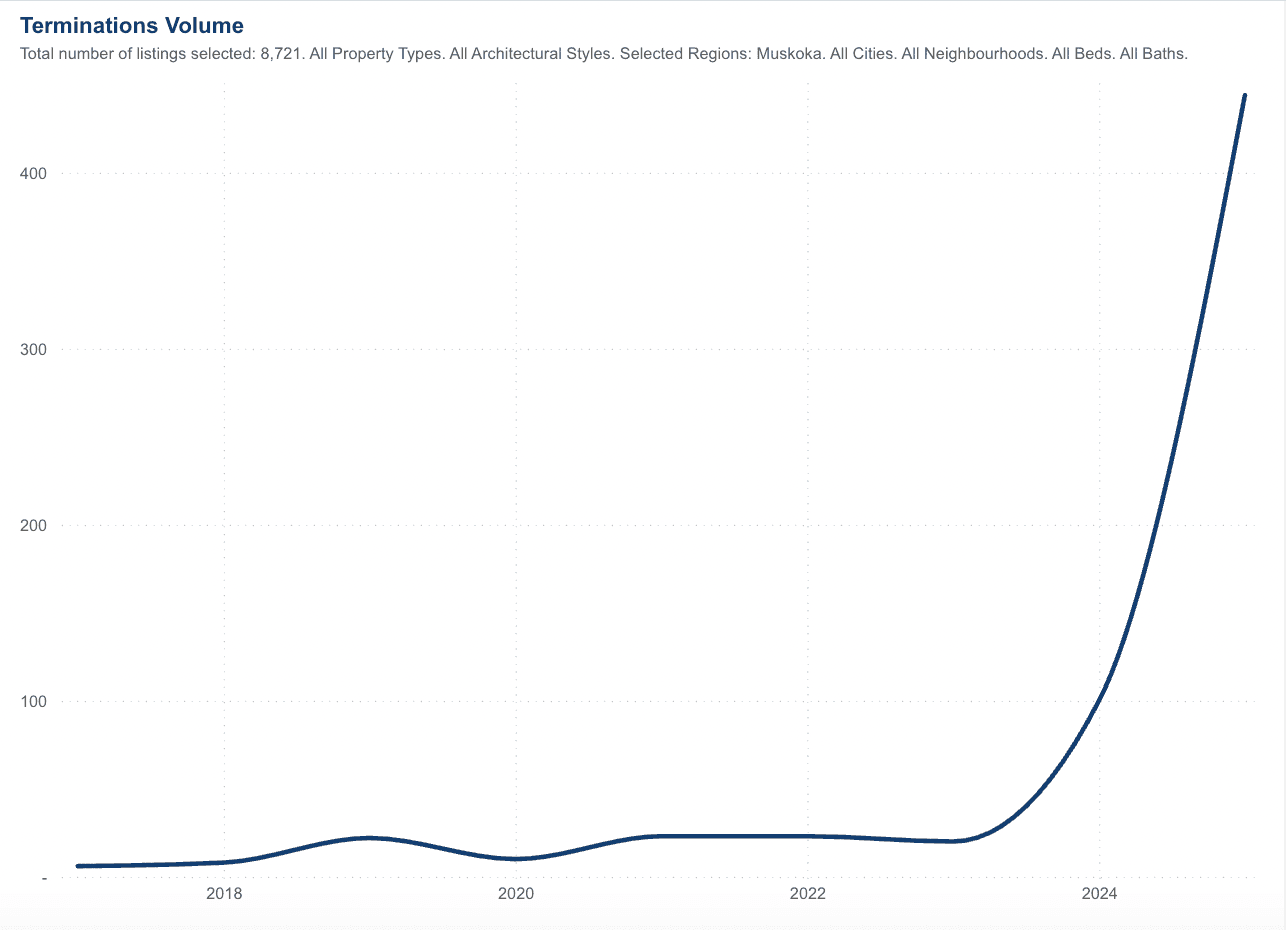
The most telling number in the whole year was listing terminations, which rose 344%. Terminations count listings withdrawn without selling. A jump of that size points to widespread repositioning: sellers pulling listings and bringing them back at prices closer to what the market will actually pay.
2025 Numbers in a Nutshell
- 561 waterfront properties sold up 1.4% Y/Y
- Average Days on Market - 55
- Median price $950,000 down 2.2% Y/Y
- 14.5 average months inventory up 55% Y/Y
- 1846 new listings, above historic averages
- 62 Luxury cottage sales over $3,000,000.00
- Termination Volume up 344% Y/Y
Google Search Continues to Decline
As we've pointed out in previous market outlooks, search analytics are one of our most consistent leading indicators. This chart below illustrates the powerful correlation between Google Search and cottage sales activity in the Muskoka region. The Search Interest Index (represented by the orange dashed line) is measured on a normalized scale of 0 to 100, where 100 represents the historical peak of search volume for terms such as 'Muskoka cottages for sale' and 'waterfront cottages for sale'. By using this index, we can compare high-level search trends against actual sales units on a single timeline. The data shows that as searches for these key terms surged to their 100-point peak during the pandemic, sales volumes followed suit. Conversely, the current trend shows a synchronized retreat; as the index for these core search terms drops toward the 50-point mark, it signals a significant waning in buyer urgency, ultimately acting as a leading indicator for the lower sales volumes projected through 2026.
2026 Outlook
At the risk of sounding repetitive, I see 2026 in Muskoka looking a lot like last year. A meaningful share of listings didn’t sell by late summer, and we expect many of those properties to return to the market—often at lower asking prices. Combined with new inventory coming on, that should keep supply elevated and competition firm.
On the demand side, the headwinds we’ve been tracking remain in place. The largest, by a wide margin, is the economic uncertainty tied to the ongoing—and still evolving—trade dispute with the U.S. In my view, this factor outweighs the rest of the concerns combined. In candid conversations with agents and brokers across the region, it is consistently the most common and most serious issue heading into the 2026 selling season.
Google Search Trends represent a key leading indicator in our forecasting model. The strong historical correlation between search volume and transaction levels remains evident; as search interest continues its downward trajectory, we anticipate a corresponding impact on sales volume.
With that as the backdrop, here is how we see the Muskoka cottage market in 2026:
Inventory remaining well above historical averages, with the potential to rise another ~10% versus 2025.
List-to-sale spreads tighten as sellers relist closer to current market reality.
Prices drift modestly lower, generally down 5–10% year-over-year.
Early-season velocity stays subdued as buyers and sellers search for workable middle ground; sales volumes down ~10%.
Smaller lakes continue to show higher price sensitivity and greater vulnerability to negotiation.
Core lakes—Joseph, Rosseau, Muskoka, and Lake of Bays—should remain comparatively more stable due to deeper demand and more consistent liquidity. See our in-depth market analysis here.
Waterfront Sales in Muskoka 2010-2025 with 2026 Projection
Notes: Annual sales are calculated as average monthly sales × 12. The dashed line shows the long-term average (2010–2025). 2026 is a modeled projection of a 10% decline from 2025 sales.
Waterfront Listings in Muskoka | 2015-2025 with 2026 Projection
Median Sale Prices for Muskoka Waterfront 2010-2025 with 2026 Projection
Notes: Prices shown are median sale prices for Muskoka waterfront homes and cottages. The shaded area highlights the 2020–2022 pandemic period. The 2026 value reflects projection 10% below 2025. Data Source: Habistat Analytics from Multiple Real Estate Boards.
Historical Data Source - Habistat Analytics| MLS® Multiple Real Estate Boards
Listing Terminations in Muskoka 2017-2025
Historical Data Source - Habistat Analytics| MLS® Multiple Real Estate Boards
How Cottage Values Change Over Time
We produce multiple market reports and publish a lot of charts and statistics to support our commentary. The downside is that the information overload can start to feel overwhelming. To simplify things, we’ve distilled the market into one straightforward example.
The chart below illustrates how the value of a typical waterfront property purchased for $400,000 in 2010 would have moved over time, based on actual year-to-year changes in median sale prices across the waterfront market. We've included Muskoka, Parry Sound, Magnetawan and Ontario for comparisons.
This is a market-wide benchmark and not a reflection of any single waterbody (for example, Lake Rosseau or Lake of Bays). Its purpose is to show the broader trajectory of the waterfront cottage market and how pricing dynamics have evolved through different cycles and in different areas.
For context, you can toggle on comparisons to Muskoka, Haliburton, Parry Sound or the overall Ontario market.
• Values are indexed to a $400,000 cottage purchased in 2010, based on median sale price movements.
• Each line shows a 12-month rolling average of the indexed value to smooth month-to-month variation.
• “Waterfront” includes all waterfront property types where applicable (not cottage-only).
• The shaded band (2020–2022) highlights the pandemic period.
• The shaded band (2026) applies an illustrative –10% adjustment spread evenly through 2026 (rolling projection).
Where is the Market Heading?
Most real estate reports look backward at sold data. We prefer to look forward. We built the Ontario Cottage Market Forecaster™, a predictive tool that reads real transaction data going back to 2010 alongside 12 economic signals, from interest rate sensitivity to luxury inventory absorption to the VIX, and projects where the market is heading next. Updated quarterly, with every input and its weighting published openly.
See the Forecast →Over the past several years, Ontario’s cottage markets have gone through multiple real estate board mergers and MLS® system changes. As data is migrated between systems, it isn’t always possible to confirm that every historical record transferred perfectly or was categorized consistently.
To provide the clearest picture we can, we rely on raw data compiled by Habistat Analytics across multiple real estate boards and apply consistent definitions over time. It includes data from :
- Toronto Regional Real Estate Board (TRREB), incorporating the former Brampton Real Estate Board.
- Central Lakes Association of Realtors, covering areas like Durham, Quinte, and Peterborough.
- Ottawa Real Estate Board (OREB).
- London and St. Thomas Association of Realtors.
- Niagara Association of Realtors (NAR).
- Kingston & Area Real Estate Association (KAREA).
- One Point Association of Realtors (Muskoka, Parry Sound, Simcoe, Haliburton, Orillia ect.).
- Oakville, Milton & District Real Estate Board
Questions or comments? Contact John Fincham, Broker @ Re/Max Parry Sound Muskoka Realty Ltd. Brokerage