
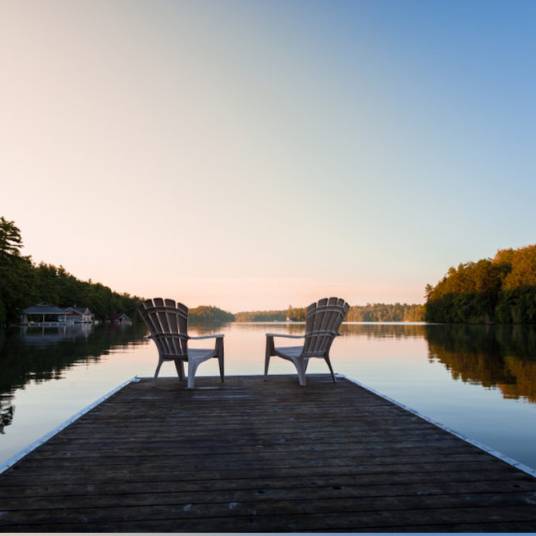
Lake Joseph
One of the most sought-after addresses in cottage country.
Lake Joseph — Lake Joe to anyone who's spent time on it — sits at the top of Muskoka's Big Three alongside Lakes Rosseau and Muskoka. The three lakes connect through the narrows at Port Sandfield and Port Carling, which means a boat trip can take you across all of them in a single afternoon. But Joe has its own character. The water is the clearest of the three. The shorelines tend to be longer, the lots more private, and the overall feeling quieter.
It sits primarily in Seguin Township, within the District of Parry Sound, and its shores touch the villages of Port Carling, Port Sandfield, Minett, and Mactier. There are more than 60 islands on the lake, many with historic cottages. It's about two hours from Toronto depending where on the lake you land.
140 km
Total Shoreline
93 m
Maximum Depth
6.7 m
Water Clarity
~1,250
Shoreline Properties
A Lake With Deep Roots
The Muskoka region is the traditional territory of the Anishinaabeg — the Ojibwe, Odawa, and Potawatomi Nations collectively — who have inhabited these lands for over 10,000 years. The area was covered by glacial Lake Algonquin following glacial recession around 10,000 years ago, which shaped the Canadian Shield bedrock and sandy substrates that define the landscape today.
The lake was named by William Robinson — a member of the House of Assembly for Upper Canada and later Commissioner of Public Works — after his friend Joseph Rousseau, whose father was a fur trader in the area. Robinson also named neighbouring Lake Rosseau.
European settlement accelerated after the Free Grants and Homestead Act of 1868, which allotted settlers 15 acres of Muskoka land. But the Canadian Shield proved poor farmland, and by the late 1800s the region had pivoted toward tourism — supported by road, rail, and steamboat infrastructure that had originally been built for logging and agriculture. Cottage development on Lake Joseph began in the 1870s and spread quickly across all three of the Big Three lakes.
What Sets Lake Joseph Apart
The clearest of the Big Three
Lake Joseph is fed largely by spring water traced upstream to Algonquin Park. It's an oligotrophic lake — meaning the organisms in it survive on minimal nutrients — which keeps the water exceptionally clear. Visibility reaches 6.7 metres, the best of the three lakes, and makes for outstanding swimming, snorkeling, and fishing.
Connected but private
Lake Joe connects to Lake Rosseau through the narrows at Port Sandfield and the Joseph River, opening up over 500 km of navigable waterway across the Big Three. Despite that connectivity, the lake itself tends to feel quieter than some others. Frontages tend to be longer and strict development controls have created a sense of privacy that's harder to find on busier lakes.
More than 60 islands
Many of Lake Joseph's islands — Frazer, Blueberry, Emerald, Burnt, Round, Turtle, Dahmawah, Wegamind, Playfair, Gitchie, among others, have cottages that have been in the same family for generations. Owners typically dock at one of the lake's several marinas and rent a slip and parking annually. It's a different kind of cottage experience, and many people who know the lake wouldn't have it any other way.
Fishing, on a serious lake
The Ministry of Natural Resources has tracked Lake Joseph as a trend lake under its Broad-scale Monitoring program. The fishery includes lake trout, smallmouth and largemouth bass, northern pike, walleye, muskellunge, lake whitefish, and burbot. From 2003 to 2009, the average abundance of lake trout over 30 cm was estimated at 36,000 fish — a healthy, monitored population.
Lake Joseph, along with Little Joe, have fewer properties than either Rosseau or Muskoka. That limited supply — combined with consistant demand — is what keeps it at the top of the Muskoka market year after year.
—A Low-Inventory,
High-Prestige Market.
Lake Joseph has roughly 1,250 shoreline properties — the fewest of the Big Three lakes. Many cottages have been in the same family for generations and rarely come to market. When they do, the combination of limited supply, enduring demand, and strict development controls keeps prices at the top of the Muskoka range. The average waterfront price across the Big Three lakes was over $3 million as of early 2026, and Lake Joseph and Rosseau consistently trade at a premium to that figure.
Properties span classic Muskoka cottages with old-growth character to contemporary waterfront estates. What they share: generally longer shoreline frontages, more acreage, and a level of privacy that's built into the lake's character. Exposure matters — south- and west-facing lots command the most interest for afternoon sun and sunset views. Existing boathouses and grandfathered shoreline structures add meaningful value given current permitting restrictions.
Water-level on Lake Joseph is regulated by an MNR-owned dam at Port Carling under the Muskoka River Water Management Plan — worth understanding before buying.
12 signals
Real-time economic indicators tracked by our Ontario Cottage Market Forecaster™ — interest rate sensitivity, luxury inventory absorption, the VIX, and more.
Current Conditions
on Lake Joseph.
As of early 2026, the Lake Joseph market has moved into a more negotiation-friendly environment following price corrections through 2024 and 2025. The pandemic-era surge has settled, and while the ultra-luxury segment above $8M remains relatively insulated, the $3M–$5M range is seeing more buyer leverage than it has in years.
The broader Muskoka waterfront market saw 561 sales in 2025 — a modest 1.4% increase from 2024, but still roughly 25% below historic norms. Inventory exceeds 12 months on some segments. For buyers who've been waiting, conditions on Lake Joe are as favourable as they've been since before the pandemic. For sellers, pricing realistically matters more than ever.
Rather than look backward at sold data, we track 12 real-time economic signals through our Ontario Cottage Market Forecaster™ to give both buyers and sellers a forward-looking picture of where the market may be heading.
Things to Do Around Lake Joseph
Dining on the water
The Sherwood Inn, one of the lake's classic resorts, has its own dining room. Rocky Crest Golf Resort offers On the Green Dining overlooking the course. Many of Lake Joe's restaurants are reachable by boat — which is very much the point.
Golf & outdoors
Rocky Crest Golf Resort sits directly on the lake and is one of Muskoka's most scenic courses. The region offers hiking, birdwatching, and canoeing across a range of skill levels, with the Canadian Shield landscape providing the backdrop. Cross-country skiing and snowshoeing make the lake viable year-round for those who want it.
Muskoka Lakes Farm & Winery
Just a short drive from the lake, the Muskoka Lakes Farm & Winery near Bala offers their well-known "Bog to Bottle" experience through the cranberry bogs, followed by tastings of wines and spirits made from local ingredients. It's one of the more distinctive local attractions in the region and worth a visit in fall when the cranberry harvest is on.
The boating network
Lake Joe connects to Lake Rosseau and Lake Muskoka through the lock system at Port Carling, opening up one of the best freshwater boating networks in Ontario. Port Carling village — at the intersection of the three lakes — has restaurants, shops, and services accessible by boat. The Lake Joseph Nature Association (LJNA) is an active stewardship organization for the lake, worth knowing if you're considering a purchase.
We Love Old Wooden Boats.
We have a small one at our cabin near Algonquin Park and a larger one on Ahmic Lake. There is something about the feel of wood, the sound against a wooden hull moving through the water, that can't be replicated. If you feel the same way, you'll understand why the Big Three — Joe, Rosseau, and Muskoka — mean something extra to people who care about this stuff.
These lakes were the birthplace of Canadian wooden boat building. In the late 1800s and early 1900s, Ditchburn operated out of Gravenhurst, building everything from rowboats to 100-foot luxury cruisers. Minett-Shields was in Bracebridge. Greavette and Duke Boats ran shops in Gravenhurst and Port Carling respectively — Duke's building still stands beside the Port Carling locks today. These builders set standards for craftsmanship that were, by most accounts, unsurpassed anywhere in North America. Many of the boats they built are still on these lakes.
The Muskoka Lakes Association Antique Boat Show has been held bi-annually in Port Carling since 1971 — one of the longest-running wooden boat shows in Canada. It honours boats built in Muskoka or that have spent most of their lives on Muskoka waters. The docks fill with over 60 of the finest examples on the lake, and the locks are typically closed for the day. It's worth planning a visit around.
In Gravenhurst, the Grace and Speed Boathouse at the Muskoka Steamships & Discovery Centre holds North America's largest in-water collection of classic antique wooden boats — a rotating display of restored Ditchburns, Greavettes, and others, shown afloat in summer and lifted onto beams in winter so you can see the hulls up close. If you haven't been, it's one of the genuinely special things about this part of Ontario.
A boathouse with a vintage wooden boat adds something to a Lake Joseph property that's hard to quantify on a listing sheet but easy to feel the moment you pull up the dock.
Interested in Lake Joseph?
Give us a call and tell us what you're thinking — whether you're actively looking, just starting to explore, or want to understand what your property might be worth.