
Market

Market

Comparative Long-Term Waterfront Market Trends: Lake Muskoka, Lake Rosseau & Lake Joseph

Lake Joseph, Muskoka

I often get asked if Lake Muskoka, Lake Rosseau, and Lake Joseph are considered the same "luxury" market and how they compare to the overall Muskoka cottage market. I was aware that they acted somewhat different from each other but I couldn't find any current articles on the subject. After researching historical data from the last decade I found they do indeed behave differently not only from one another, but from the broader Muskoka waterfront. While all lakes share long-term demand and limited supply, differences in scale and buyer composition produce distinct pricing patterns across market cycles. Using M.L.S.® sales data and observing longer-term trends, this analysis examines how the Big Three have navigated expansion, pandemic-era distortion, and normalization—and why their long-term performance continues to diverge from Muskoka’s smaller and mid-sized lakes.

Data & Methodology Note:
This analysis is based on available MLS® sales data from multiple real estate boards via Habistat Analytics. In the last few years there have been multiple board changes and mergers so obtaining precise data can be challenging. We have attempted to be very accurate, however, figures should be taken as approximate and intended to illustrate long-term behaviour rather than precise valuations. In markets with limited transaction volume, individual sales can disproportionately influence averages. The data does not include private or exclusive transactions, and findings should be interpreted as directional insights rather than predictive or definitive measures of future performance.

Lake Muskoka

Lake Muskoka — Market Behaviour Summary

(Pandemic surge defined as 2021–2023)

Annual sales volume (normalized)

Lake Muskoka is the most liquid and consistently traded waterfront market in Muskoka. Outside of the pandemic surge years of 2021–2023, the lake typically records between 50 and 85 waterfront transactions annually, a level of activity that supports statistically meaningful annual median pricing and reliable long-term trend analysis.

This depth of transaction volume distinguishes Lake Muskoka from Lake Rosseau and Lake Joseph, where thin trading can amplify short-term volatility. As a result, Lake Muskoka provides the clearest view of true market price discovery within Muskoka’s Big Three.

Long-term price appreciation — pre-pandemic baseline

Using annual medians to account for seasonality and transaction clustering, Lake Muskoka demonstrates exceptionally strong structural price appreciation over the pre-pandemic period. From approximately 2010 through 2020, annual median sale prices increased from roughly $480,000 to approximately $1.9 million.

This represents a compound annual growth rate in the mid-teens (approximately 14–15%), achieved without extraordinary supply constraints or demand shocks. Importantly, this appreciation unfolded across multiple interest-rate environments and market cycles, underscoring Lake Muskoka’s role as a fundamentally resilient, demand-driven market rather than a speculative one.

Pandemic-period distortion (2021–2023)

The years 2021 through 2023 introduced an atypical surge in demand that temporarily disrupted established pricing trends. Elevated buyer urgency, combined with compressed inventory, pushed pricing beyond long-term trend lines and produced headline figures that materially exceeded historical norms.

While this period lifted absolute price levels, it should be interpreted as a temporary demand shock, not a new structural baseline. The pandemic years effectively pulled forward future demand rather than redefining underlying market value.

Post-pandemic recalibration

Following the surge, Lake Muskoka has undergone a measured and orderly recalibration, not a collapse. Transaction volumes moderated first as buyers became more selective, followed by repricing as sellers adjusted expectations. This sequencing is characteristic of a liquid market engaged in price discovery, rather than one experiencing stress or forced selling.

Unlike thinner markets, where price adjustments can be abrupt, Lake Muskoka’s depth has allowed normalization to occur gradually and transparently.

Price sensitivity and market signalling

Because of its scale and transaction depth, Lake Muskoka responds more quickly to changes in interest rates, credit conditions, and buyer sentiment—particularly in the sub-$3 million segment—than Lake Rosseau or Lake Joseph. As a result, it consistently functions as a leading indicator for broader Muskoka waterfront market direction.Changes in absorption rates, pricing momentum, and negotiation dynamics typically appear on Lake Muskoka before filtering into the more supply-constrained lakes.

Sale-to-list price confirmation

Sale-to-list price ratios on Lake Muskoka reinforce this interpretation. Post-pandemic adjustments have been driven by pricing normalization rather than market stress, with negotiated outcomes remaining orderly and broadly consistent with long-term norms. Early signs of stabilization are now emerging, indicating that underlying demand remains present, with buyers largely waiting for prices to realign with long-term value rather than exiting the market.

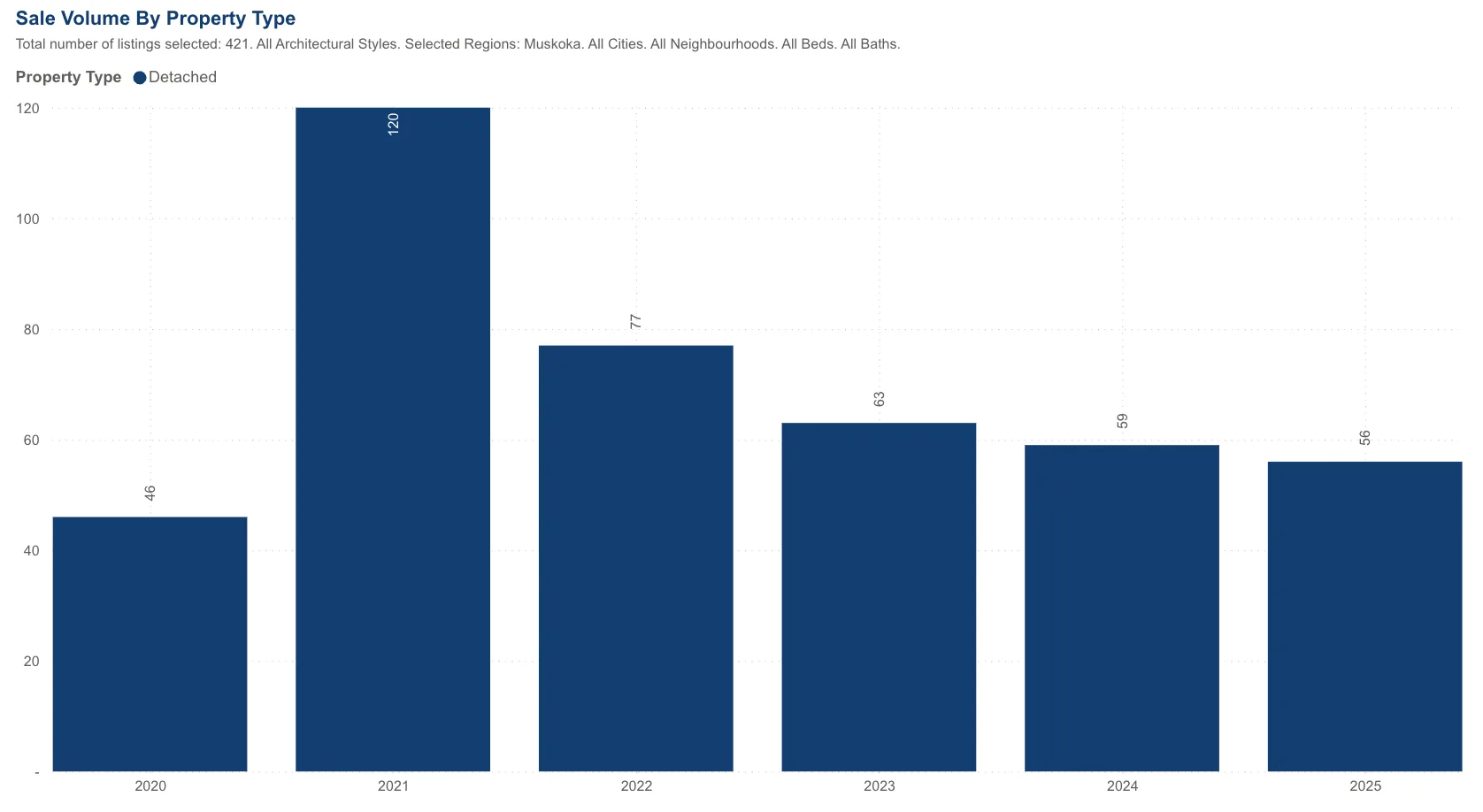
Lake Muskoka Cottage sales
Lake Muskoka | Data Source - Habistat Analytics
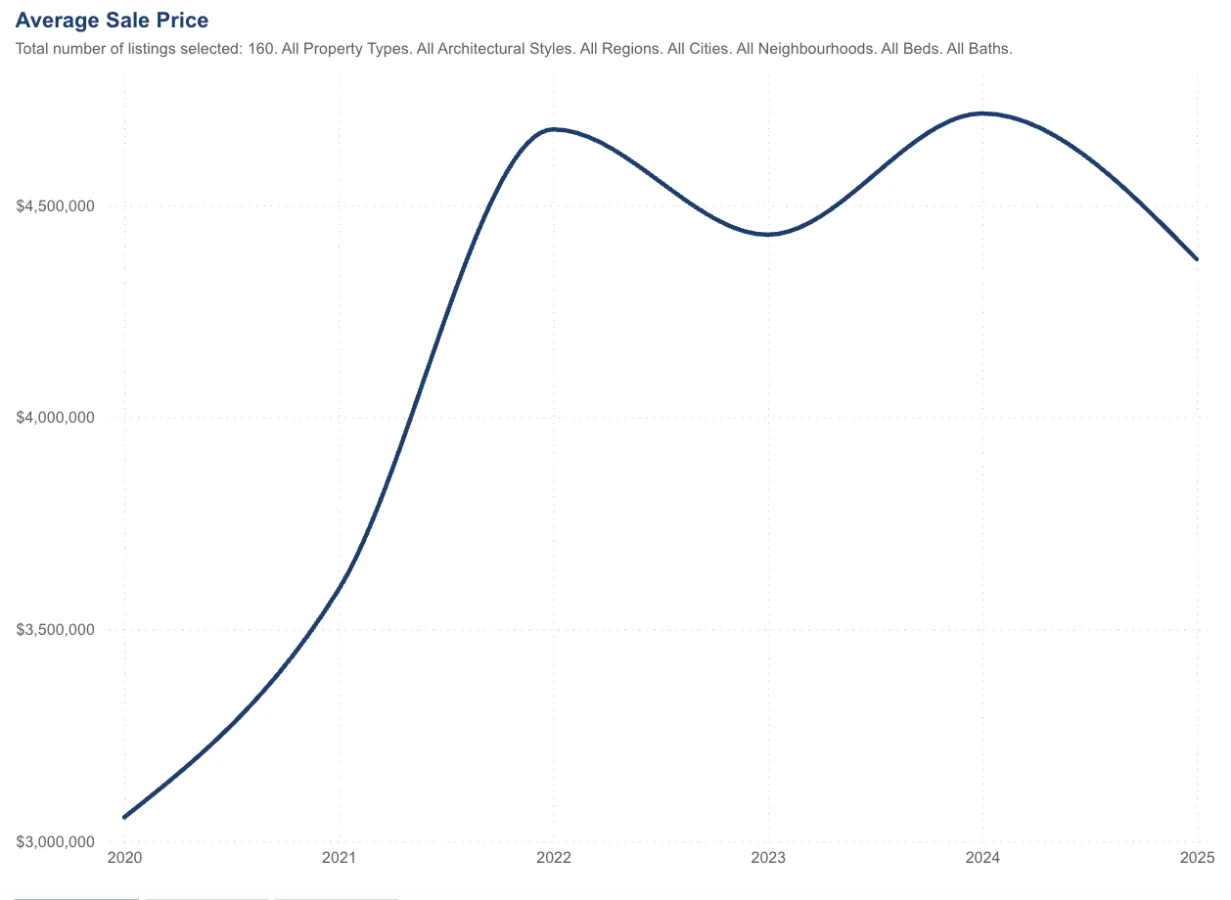
Lake Muskoka cottages -average price
Lake Muskoka | Data Source - Habistat Analytics
Lake Muskoka list price/sale price
Lake Muskoka | Data Source - Habistat Analytics

Lake Muskoka — Relative Price Volatility

Year-over-year percentage change in annual median waterfront prices, comparing Lake Muskoka with the broader Muskoka waterfront market from 2015 through 2025. Early pandemic-related shifts in buyer behaviour emerged in 2019, with the most pronounced effects occurring between 2020 and 2022.

Pandemic demand distortion (2020–2022) +40% +20% 0% −20% 2015 2017 2019 2021 2023 2025
Lake Muskoka
All Muskoka waterfront
Annual percentage changes are calculated using annual median sale prices. Lake Muskoka’s higher transaction volume produces faster price discovery and greater short-term volatility than lower-turnover lakes. Early behavioural shifts began in 2019; the shaded period (2020–2022) reflects when pandemic-driven demand distortion became statistically measurable. Data through calendar year 2025.

Lake Rosseau

Lake Rosseau — Market Behaviour Summary

(Pandemic surge defined as 2021–2023)

Annual sales volume (normalized)

Outside of the pandemic surge years, Lake Rosseau consistently records lower annual transaction volumes than Lake Muskoka, typically in the low double digits. This reduced liquidity necessitates the use of annual medians rather than monthly pricing, as individual transactions can disproportionately influence short-term statistics. The result is a market that trades less frequently, but often at higher individual price points.

Long-term price appreciation — pre-pandemic baseline

When evaluated using annual medians, Lake Rosseau demonstrates strong long-term price appreciation, though with greater year-to-year variability than Lake Muskoka due to thinner trading volume. Over the pre-pandemic period (approximately 2010–2020), pricing growth reflects a structurally supply-constrained, prestige-oriented market, where appreciation has been driven less by turnover and more by long-term ownership and limited availability of premium waterfront.

While annual growth rates are inherently less smooth than on Lake Muskoka, the underlying trend shows consistent upward pressure over multiple market cycles, reinforcing Rosseau’s position as a scarcity-driven market rather than a volume-driven one.

Pandemic-period distortion (2021–2023)

The 2021–2023 period introduced a pronounced but uneven demand shock on Lake Rosseau. Limited inventory combined with elevated discretionary demand produced outsized pricing responses to relatively small changes in transaction count. As a result, pandemic-era pricing should be interpreted with caution, as a handful of high-value sales materially influenced annual medians.

This period represents demand compression and pricing distortion, not a fundamental redefinition of market value.

Post-pandemic recalibration

In the post-pandemic environment, Lake Rosseau has adjusted primarily through reduced transaction volume rather than aggressive price erosion. Sellers have generally demonstrated a greater willingness to wait, reflecting a buyer base that is less sensitive to short-term market cycles and more oriented toward long-term ownership.

Price adjustments, where they have occurred, have been selective and property-specific rather than broad-based—consistent with a low-liquidity, high-quality asset market.

Price sensitivity and market behaviour

Compared to Lake Muskoka, Lake Rosseau is less immediately responsive to interest rate changes, but more sensitive to shifts in discretionary wealth and confidence at the upper end of the market. This dynamic produces slower but more pronounced pricing movements, particularly during periods of market stress or exuberance.

As a result, Lake Rosseau tends to lag Lake Muskoka in both upswings and corrections, while ultimately following the same broader directional trends.

Sale-to-list price confirmation

Sale-to-list price ratios on Lake Rosseau indicate that post-pandemic adjustments have occurred through extended marketing periods and pricing refinement, not forced selling. The absence of widespread distress underscores the market’s structural resilience and reinforces the importance of interpreting short-term pricing data within the context of limited annual sales.

Lake Rosseau cottage sales
Lake Rosseau | Data Source - Habistat Analytics
Lake Rosseau cottage price chart
Lake Rosseau | Data Source - Habistat Analytics
Lake Rosseau listing/sale price percentage

Lake Rosseau — Relative Price Volatility

Year-over-year percentage change in annual median waterfront prices, comparing Lake Rosseau with the broader Muskoka waterfront market from 2015 through 2025. Early pandemic-related shifts in buyer behaviour emerged in 2019, with the most pronounced effects occurring between 2020 and 2022.

Pandemic demand distortion (2020–2022) +40% +20% 0% −20% 2015 2017 2019 2021 2023 2025
Lake Rosseau
All Muskoka waterfront
Annual percentage changes are calculated using annual median sale prices. Lake Rosseau exhibits moderate annual transaction volume relative to Lake Muskoka, resulting in smoother price adjustments but occasional year-to-year variability. Early behavioural shifts began in 2019; the shaded period (2020–2022) reflects when pandemic-driven demand distortion became statistically measurable. Data through calendar year 2025.

Lake Joseph

Lake Joseph — Market Behaviour Summary

(Pandemic surge defined as 2021–2023)

Annual sales volume (normalized)

Lake Joseph is the least liquid of Muskoka’s Big Three lakes, with annual waterfront transaction volumes typically in the low double digits outside of exceptional market conditions. Many months record no sales at all, making monthly pricing metrics statistically unreliable. As a result, meaningful analysis on Lake Joseph requires annual aggregation, with careful attention to transaction counts and property mix.

Long-term price appreciation — pre-pandemic baseline

When assessed using annual medians, Lake Joseph exhibits strong long-term price appreciation, though with greater variability than either Lake Muskoka or Lake Rosseau. Over the pre-pandemic period (approximately 2010–2020), price growth reflects a market defined less by turnover and more by extreme supply scarcity, limited shoreline availability, and a long-term ownership profile.

Unlike Lake Muskoka, where appreciation is reinforced by transaction depth, or Lake Rosseau, where prestige and scarcity balance one another, Lake Joseph’s pricing is shaped by infrequent but high-impact transactions. As a result, year-to-year movements can appear abrupt, even when underlying market value remains stable.

Pandemic-period distortion (2021–2023)

The pandemic surge had a disproportionate impact on Lake Joseph. With so few transactions, even a small increase in buyer urgency and a handful of ultra-premium sales materially lifted annual medians beyond historical trend lines. While headline prices rose sharply during this period, the effect reflects demand compression into an exceptionally thin market, not a structural reset of long-term value.

Pandemic-era pricing on Lake Joseph should therefore be viewed as situational rather than foundational.

Post-pandemic recalibration

In the post-pandemic period, Lake Joseph has shown remarkable pricing stability relative to its low transaction volume. Rather than widespread repricing, the market has adjusted primarily through reduced sales activity, with many owners opting not to transact at all. This behaviour is consistent with a market dominated by discretionary sellers who are under little pressure to sell.

Where price adjustments have occurred, they have been highly property-specific, reflecting differences in frontage, exposure, legacy structures, and redevelopment potential rather than broad market weakness.

Price sensitivity and market behaviour

Lake Joseph is less sensitive to interest rates and short-term sentiment than the broader Muskoka real estate market. Buyer decisions are more closely tied to long-term lifestyle considerations, intergenerational ownership, and capital preservation. As a result, Lake Joseph often lags broader market corrections and can appear disconnected from regional averages in both rising and falling markets.

This insulation, however, comes at the cost of greater short-term volatility in reported metrics, due entirely to low transaction counts rather than unstable demand.

Sale-to-list price confirmation

Sale-to-list price ratios on Lake Joseph support this interpretation. Even during periods of broader market softening, negotiated outcomes have remained relatively firm, with adjustments occurring through longer marketing periods and selective repricing rather than aggressive discounting. The data suggests that demand has not exited the market; rather, both buyers and sellers are waiting for alignment on value.

Note: These statistics do not include transactions on Little Lake Joseph, see below.

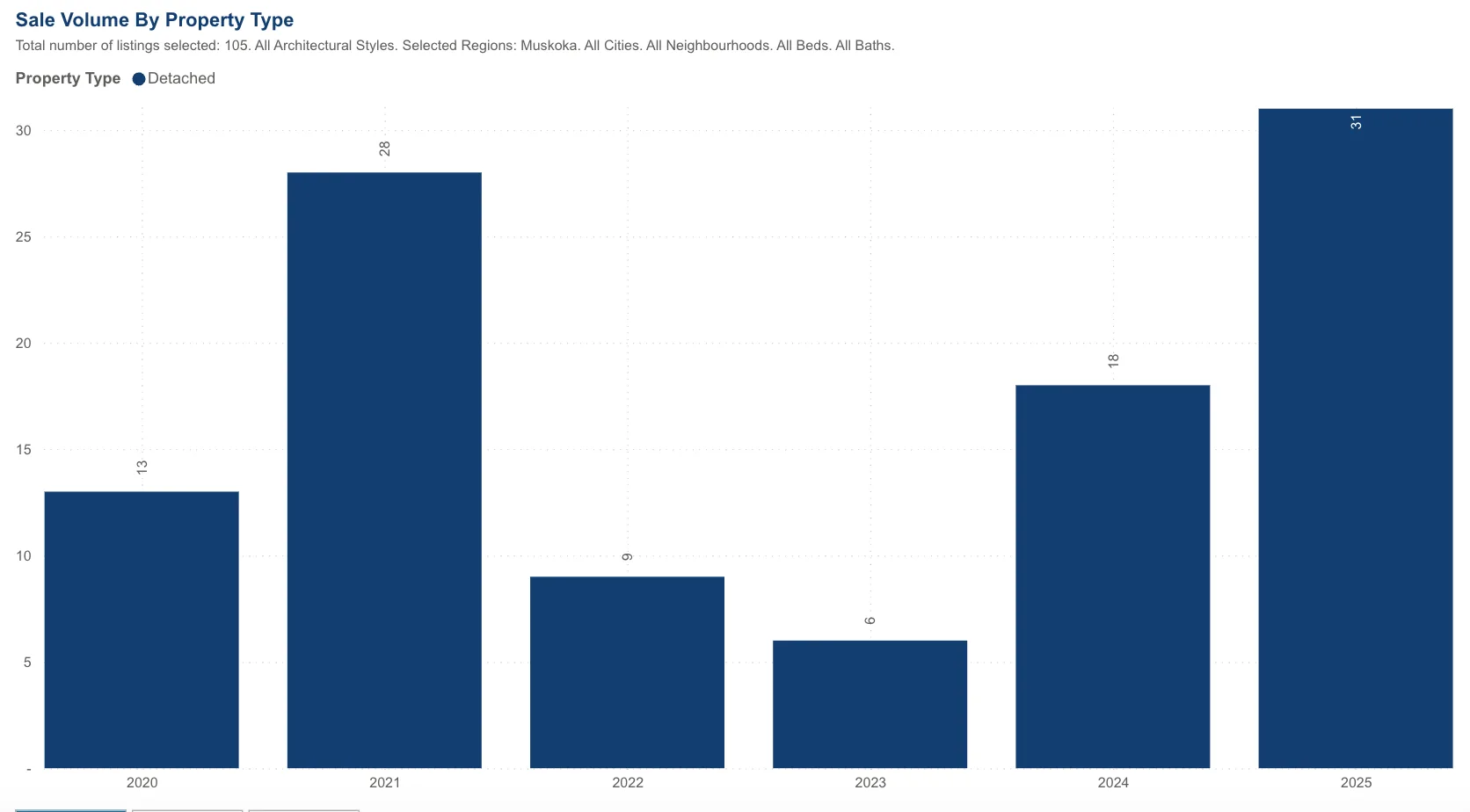
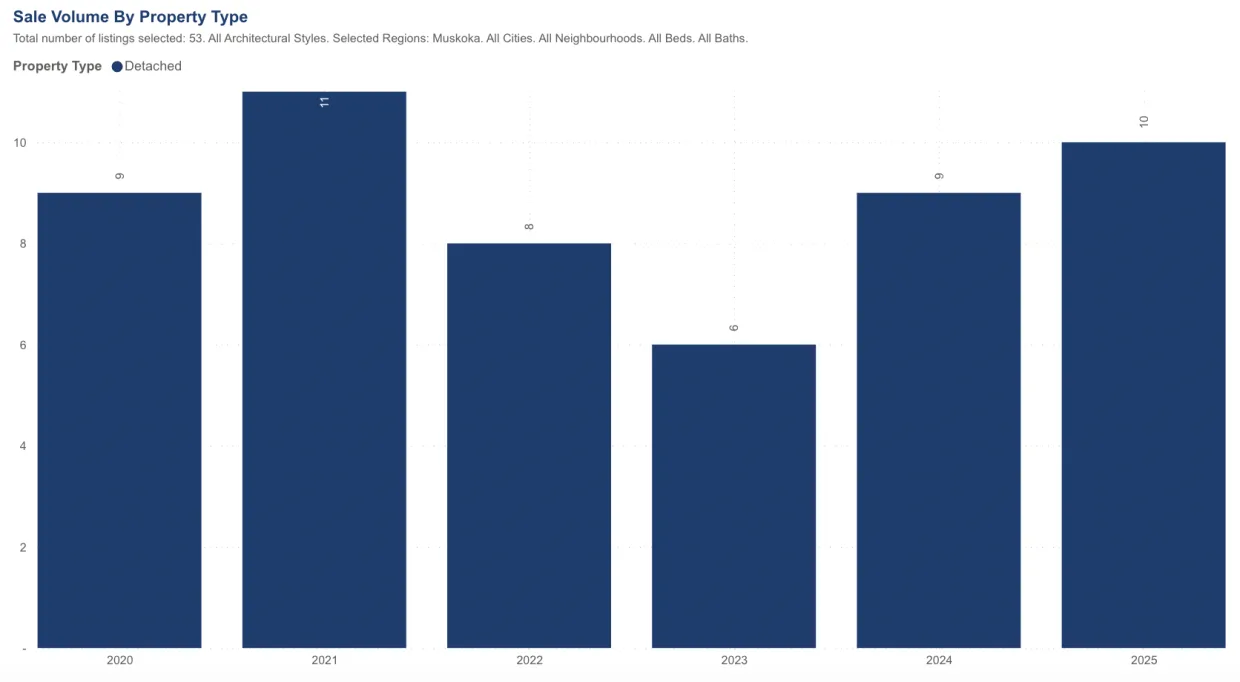
Lake Joseph cottage sales 2020-2025
Data Source - Habistat Analytics
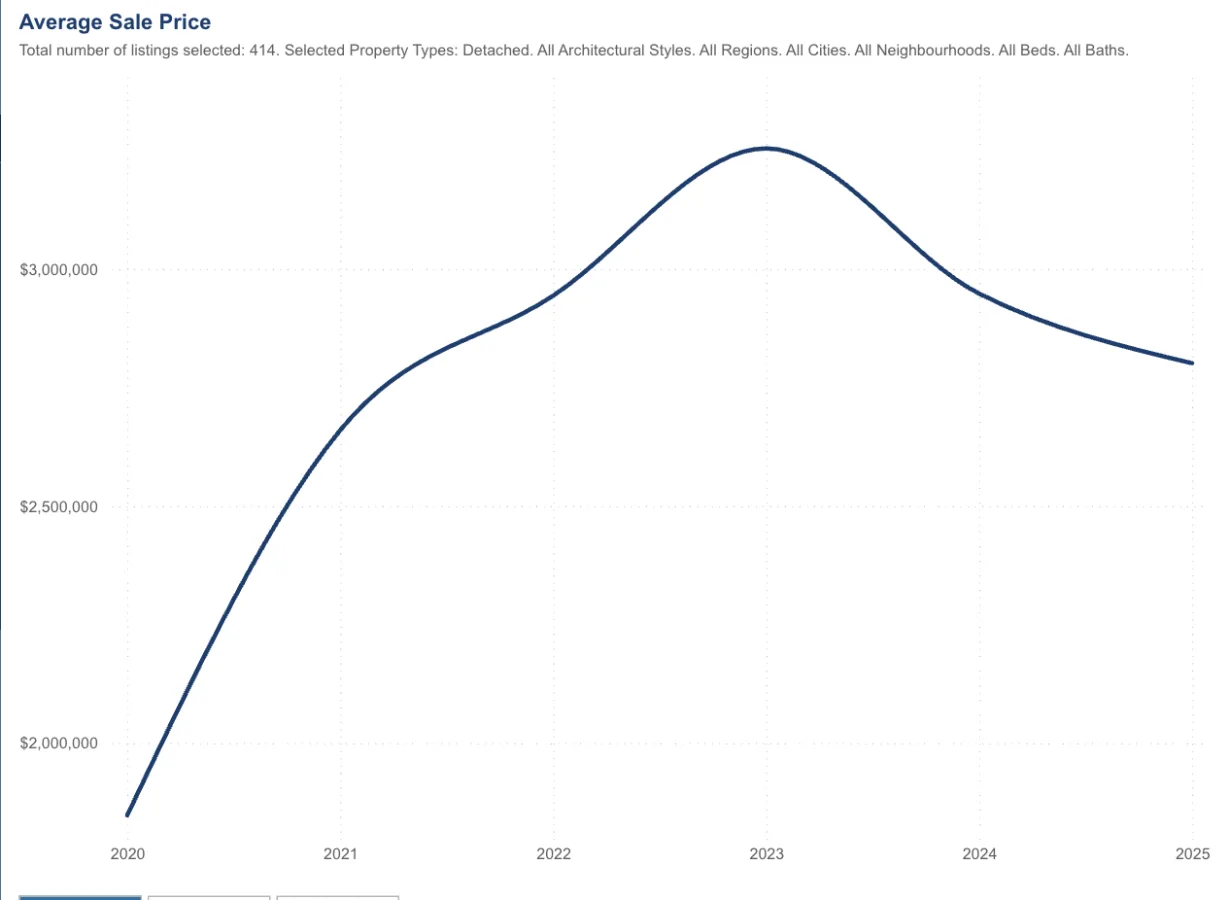
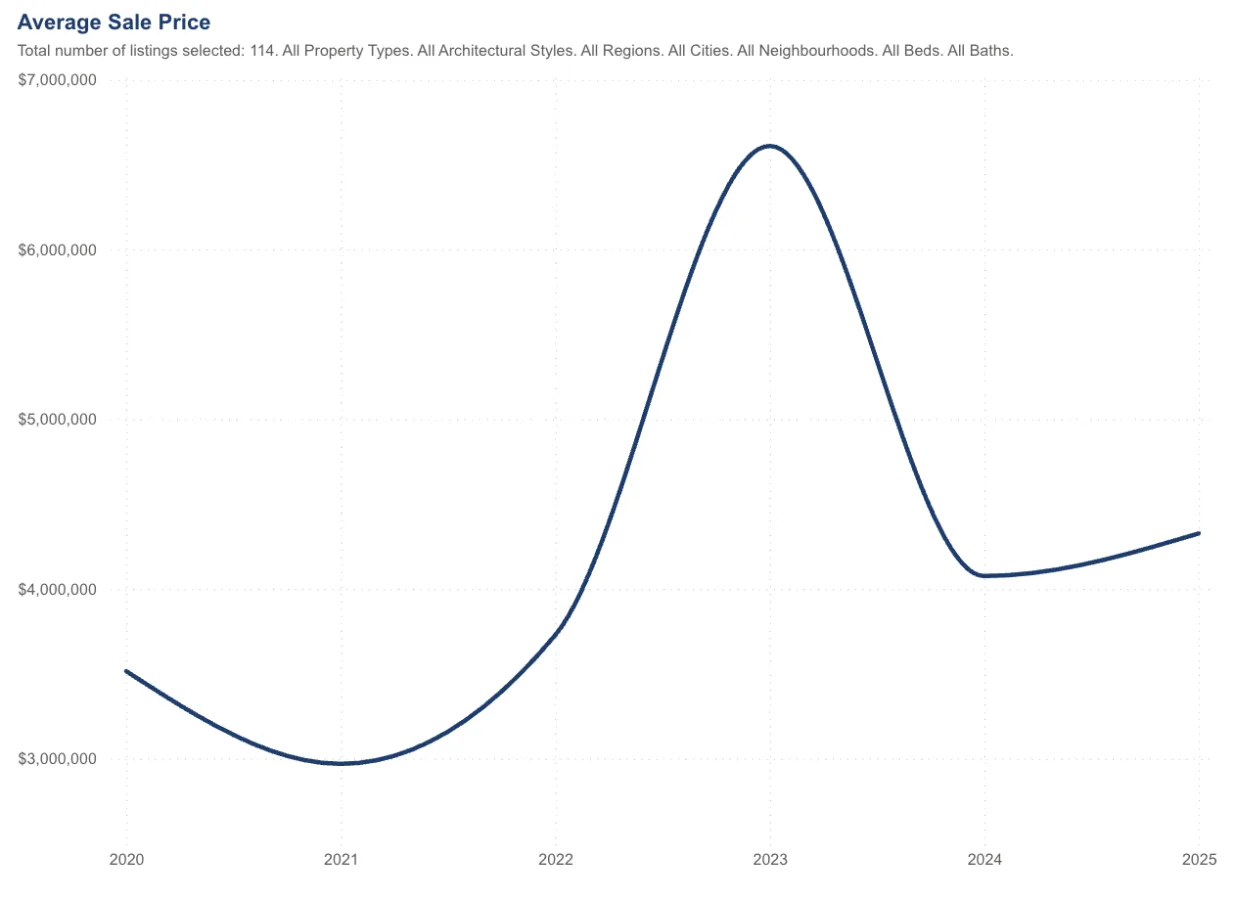
Lake Joseph Average Sale Price
Lake Joseph | Data Source - Habistat Analytics
Lake Joseph listing price to sale price
Lake Joseph | Data Source - Habistat Analytics

Lake Joseph — Relative Price Volatility

Year-over-year percentage change in annual median waterfront prices, comparing Lake Joseph with the broader Muskoka waterfront market from 2015 through 2025. Early pandemic-related shifts in buyer behaviour began in 2019, with the most pronounced effects occurring between 2020 and 2022.

Pandemic demand distortion (2020–2022) +40% +20% 0% −20% 2015 2017 2019 2021 2023 2025
Lake Joseph
All Muskoka waterfront
Annual percentage changes are calculated using annual median sale prices. Lake Joseph exhibits relatively thin annual transaction volume, which can amplify year-to-year percentage movement without implying a structural change in demand. Early behavioural shifts began in 2019; the shaded period (2020–2022) reflects the phase when pandemic effects became statistically measurable. Data through calendar year 2025.

A Note on Little Lake Joseph: A Distinct Micro-Market


It has been my experience that people often group Little Lake Joseph informally with Lake Joseph, but from a market perspective it functions as a somewhat separate, boutique micro-market. While connected to the Joseph–Rosseau-Muskoka system, its smaller size and limited number of properties create a different buyer dynamic.

Recent transactions (2019–2025) show a wide price range, with most sales clustering between $3M and $7M. Transaction volume is extremely low - often just 1 or 2 a year -  which means individual properties can materially influence perceived pricing in any given year.

Unlike core Lake Joseph, Little Lake Joseph pricing is more closely tied to property-specific attributes such as privacy, frontage quality and exposure. Several recent sales occurred at or near list price—even during softer market periods—highlighting consistent demand for well-located, qualty waterfront and well-designed lake homes.

For both buyers and sellers, short-term medians are a poor valuation tool on Little Lake Joseph. Transaction volume is simply too limited, and individual sales can distort headline statistics. Over a multi-decade horizon, however, pricing on Little Lake Joseph has shown exceptional stability—driven less by market cycles than by highly localized factors such as waterfront characteristics, access, and buyer intent. Successful decision-making here depends almost entirely on lake-specific knowledge and case-by-case analysis, not broader Muskoka averages or regional trend data.

Annual Absorption Rates — Muskoka’s Big Three vs All Muskoka (2015–2025)

Pandemic demand distortion (2020–2022) 80% 60% 40% 20% 0% 2015 2017 2019 2021 2023 2025 Lake Muskoka Lake Rosseau Lake Joseph All Muskoka

Methodology note: Annual absorption rates are calculated as total annual waterfront sales divided by total annual new listings. Annual aggregation is used to normalize markets with differing transaction depth and to avoid distortion from months with limited or no sales activity. The shaded 2020–2022 period reflects a temporary pandemic-driven demand shock rather than a permanent structural change in Muskoka’s waterfront market.

Lake Muskoka and the other Big Three reached peak absorption earlier in the pandemic cycle, reflecting faster behavioural shifts among discretionary sellers and buyers, particularly in higher-end segments. The broader Muskoka waterfront market peaked roughly a year later, as demand flowed into a larger, more financing-dependent pool of properties—confirming Lake Muskoka’s role as an early indicator while Lake Rosseau and Lake Joseph moderate volatility through selective, luxury-driven participation on both buyer and seller levels.

Muskoka’s Big Three — Relative Price Volatility

Year-over-year percentage change in annual median waterfront prices, comparing Lake Muskoka, Lake Rosseau, Lake Joseph, and the broader Muskoka waterfront market from 2015 through 2025.

Pandemic demand distortion (2020–2022) +40% +20% 0% −20% 2015 2017 2019 2021 2023 2025
Lake Muskoka
Lake Rosseau
Lake Joseph
All Muskoka waterfront
Annual percentage changes are calculated using annual median sale prices. Some individual years reflect relatively thin transaction volume on certain lakes. As a result, year-to-year percentage changes may exhibit greater variability and should be interpreted in the context of longer-term trends rather than in isolation. The shaded region reflects the pandemic-driven demand distortion period (2020–2022). Data through calendar year 2025.

Differences in price volatility reflect how each market processes change. Lake Muskoka shows larger and earlier price swings because higher transaction volume allows prices—particularly below $3 million—to adjust quickly as conditions shift. Lake Rosseau and Lake Joseph exhibit smoother, more delayed price movement, as fewer transactions and discretionary selling—especially in the luxury segment above $3 million—limit short-term repricing. As a result, volatility on the Big Three is driven less by broad market pressure and more by when owners choose to participate, rather than by changes in underlying long-term value.

Final Interpretation

Pricing across Muskoka’s Big Three lakes is driven less by sudden changes in demand -that tends to remain relatively stable - and more by how often properties trade and when owners choose to sell.

Lake Muskoka generally adjusts first because it has the largest and most consistent sales volume resulting in higher highs and lower lows. More transactions mean prices react faster to shifts in buyer behaviour, making Lake Muskoka an early signal for where the broader market is heading. Lake Rosseau tends to follow with a delay because fewer properties trade. Lake Joseph shows the least short-term movement of all—not because demand is different, but because fewer owners tend to sell, so price signals emerge slowly.

At the top end of the market, waterfront buyers are usually not constrained by as much by mortgage rates or short-term economic news. Purchases are driven mainly by discretionary capital. As a result, the price swings we see—especially at the higher price points—reflect when owners decide to participate, not a change in the underlying value of the real estate.

Across Muskoka more broadly, price adjustment happens more sporadically. There are more buyers who rely on financing, and a wider mix of property types, so the market absorbs change over time rather than all at once. This is why absorption peaked later than on the Big Three. Put simply, the volatility of 2020–2022 was not a permanent reset in Muskoka waterfront values. It was a period of unusually high activity—owners choosing to sell and buyers choosing to act—rather than a fundamental shift in what these properties are worth. Over the long run, market structure and participation matter far more than short-term price swings when interpreting value.

Comments or Questions? Contact us here.

WANT TO GET INVOLVED?

Join Our Community

Are you adventurous? Do you love the outdoors, photography and spending time up north? We're looking for content creators to be featured on our site. Contact us for more information.

finding your muskoka logo
Looking at a home or cottage for sale in the Muskoka area? Reach out and let us know what you're looking for!